UPAT
Mixed Reality · Unity · Meta Quest 3 · C# · Pico XR SDK · Eye Tracking · Medical Education · Research Applications
UPAT (Unseen Patient Attention Training) is a VR attention training program
for doctors and medical staff that I created for my bachelor's thesis.
It's designed to facilitate research studies and is currently being used by
researchers at Technische Hochschule Köln to investigate the potential effects of Visual Delegates in XR
trainings.
After finishing my work on PAULA I wanted to continue working on XR projects, but I also wanted to try
something new. So for my bachelor's thesis I decided to focus on a topic
that is different from my previous work, while keeping the focus on creating XR-trainings for emergency
responders. In consultation with my advisor and the IREX lab I decided to work
on an attention training for medical staff, which fitted one of the research lines of the lab. Therefore
the goal of the project was to create a VR training that uses the Eye Tracking of the
Pico 3 Neo Pro Eye VR headset to track the user's gaze and provide feedback on their attention. The
training was also designed to be used in research studies, so researchers can modify UPAT
in a way that fits their research questions. The training is currently being used in a research study to
investigate the effects of Visual Delegates on attention in VR trainings at the IREX Lab.
The title of my bachelor's thesis was:
Design, Implementation, and Evaluation of a VR-Based Attention Training Program for Research Using
Agile Development Methods
Before starting the implementation, I first investigated the existing research surrounding VR training
simulations, attention training, eye-tracking, and a concept called Visual Delegates. I also analysed
several comparable applications, including VERA, Wildcard, and Dimensional Search, to identify useful
design decisions and technical approaches that could be applied to UPAT.
One important finding was that VR provides opportunities to study behaviour in immersive environments
while maintaining control over the experimental conditions. Eye-tracking was particularly relevant
because it allows the application to determine where a participant is looking and how long their
attention remains focused on a particular target. This makes it possible to measure attention-related
behaviour more directly than would be possible with interaction methods based only on button presses or
head movements.
Another important part of the research was the analysis of Visual Delegates. These are visual effects
used to communicate information that would otherwise be difficult or impossible to experience directly.
They are commonly found in video games, where they can represent physical sensations or emotional
states. For UPAT, I explored how the same concept could be applied to attention: instead of only
recording that a user has stopped looking at the virtual patient, the application could also communicate
this loss of attention through changes in the virtual environment.


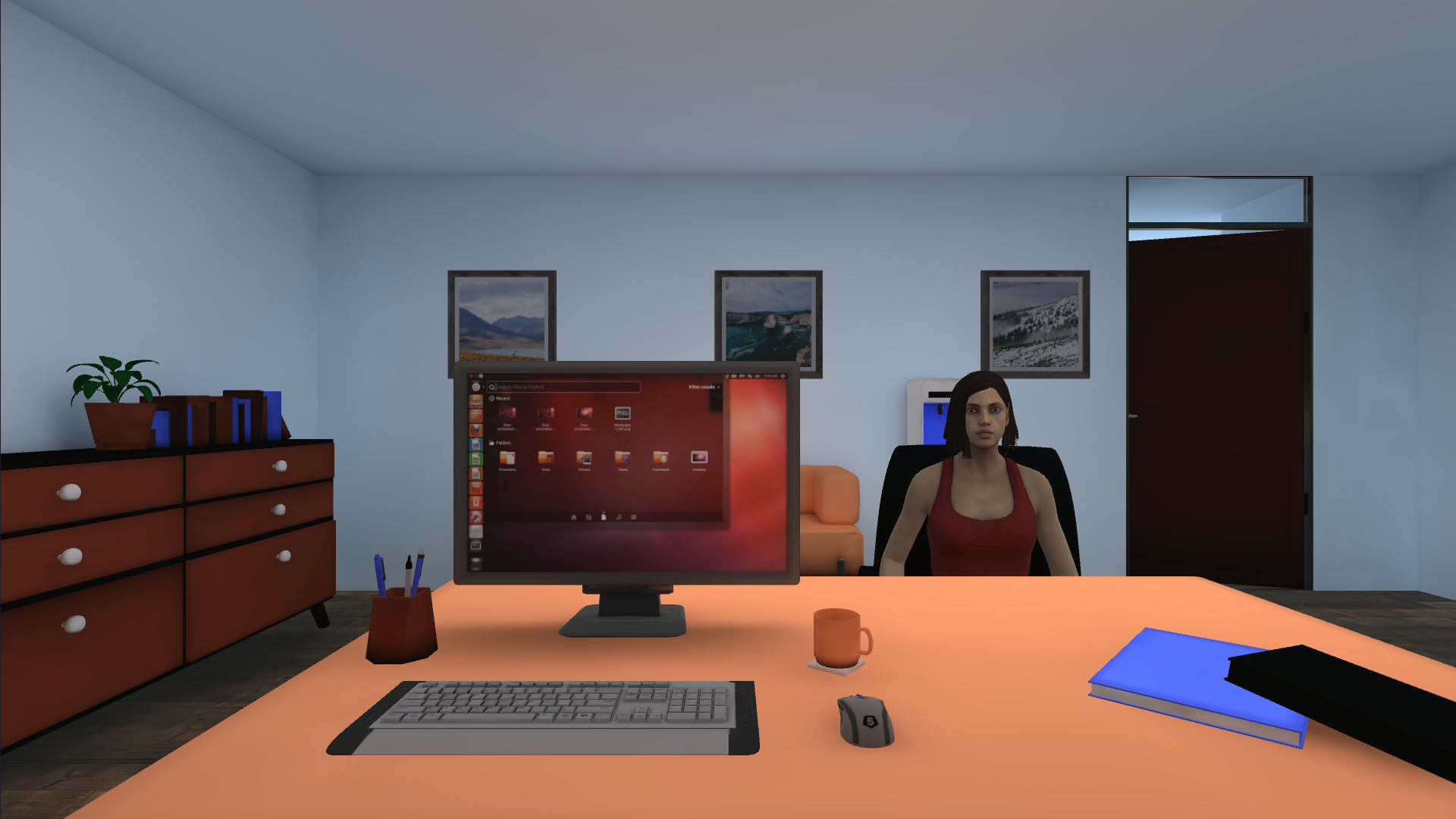
The basic training scenario is intentionally straightforward. The participant enters a virtual medical
environment and is asked to maintain their visual attention on the virtual patient. The underlying
prototype uses a PICO Neo 3 Pro Eye headset with integrated eye-tracking, allowing the application to
use the participant's gaze as the primary input for the training itself.
When the participant stops looking at the virtual patient for longer than a configurable period, the
application interprets this as a loss of attention and activates the selected Visual Delegates. These
effects provide immediate visual feedback, making the consequences of looking away noticeable to the
participant. Once the participant redirects their attention towards the patient, the effects can
gradually fade out again.
The initial implementation included three different Visual Delegates: a vignette effect, a film-grain
effect, and a grey filter. These modify the appearance of the user's field of view in different ways.
The vignette darkens the edges of the view, the film-grain effect introduces a grainy visual appearance,
and the grey filter reduces the colour intensity of the environment. Each effect can be configured
independently, and multiple effects can be combined within a single training condition.
An important part of the project was making these effects configurable instead of treating them as fixed
elements of the application. This allows researchers to investigate different combinations of visual
feedback and, in future studies, compare how different types of Visual Delegates influence attention and
user behaviour.


One of the main technical challenges was that the original prototype had been built primarily to
demonstrate the training concept, rather than to support long-term extensibility. Each Visual Delegate
had its own implementation and logic for controlling the corresponding effect. Adding new effects or
changing existing behaviour could therefore require additional code and lead to duplicated
functionality.
To address this, I redesigned the Visual Delegate system around a modular software architecture in
Unity. I introduced a shared base class that defines the common properties and functionality of every
Visual Delegate, including its name, classification, and configurable parameters. On top of this, I
implemented specialised subclasses for different types of effects, allowing shared functionality to be
reused while keeping the implementation of each specific effect separate.
Unity Scriptable Objects played an important role in this approach. They allow individual Visual
Delegates to be created and configured directly in the Unity Editor, without requiring a separate script
or changes to existing code for every new instance. Researchers can adjust the parameters of an effect
through the Inspector and create new configurations using the existing architecture.
I also implemented a Visual Delegate Manager that coordinates the active effects and controls how their
parameters change over time. This includes handling the fade-in and fade-out behaviour when an effect is
activated or deactivated. By separating the definition of an effect from the logic that manages it
during the training, the architecture became easier to maintain and extend.


In addition to individual Visual Delegates, I implemented a system for grouping multiple effects into
Visual Delegate Collections. Each collection contains a predefined combination of effects that can be
selected as a single configuration. This is particularly useful in a research context, where different
experimental conditions may require different combinations of Visual Delegates.
Instead of manually selecting and configuring every effect before each training session, researchers can
prepare collections in advance and select the appropriate configuration when starting the application.
The available collections are loaded automatically and displayed in the user interface. This also makes
it easier to introduce new experimental conditions in the future without having to modify the underlying
training logic.
Designing this architecture required more than simply making the code reusable. The goal was to make the
application accessible to researchers who might want to conduct experiments with it but would not
necessarily want to modify the source code themselves. For that reason, configurability and a clear
separation of responsibilities were central considerations throughout the implementation.
Another major part of the thesis was the development of a start menu that allows the training to be
configured directly within the application. Previously, changing training conditions required more
involvement in the development environment. With the new menu, researchers can select a Visual Delegate
Collection, inspect the effects it contains, and adjust important training parameters before starting a
session.
These parameters include the time the virtual patient can be ignored before the effects are activated,
as well as the fade-in and fade-out durations of the selected Visual Delegates. The menu also allows a
participant ID, the training duration, and the type of training run to be specified. Changes made
through the interface are passed to the corresponding systems and used during the training.
This was an important improvement because it made the application more practical for repeated
experiments. Researchers can prepare different conditions and switch between them without having to
change values manually in the code or rebuild the training logic for each configuration.


Since the application was being prepared specifically for research, collecting reliable and structured
data was another essential requirement. To support this, I implemented a Research Data Collector script that
automatically records relevant events during a training session and stores them in CSV files.
The research data collector script records events such as losses of focus and subsequent refocusing, together with timestamps
and the parameters used for the training. This information can later be processed and analysed to
investigate how participants direct their attention towards the virtual patient and how their behaviour
changes under different training conditions. The participant ID also makes it possible to associate the
generated data with the corresponding study participant.
I also implemented a dedicated training timer that controls the duration of each session and provides
elapsed-time information to other components. By combining the timer with the data collector,
attention-related events can be associated with a time during the training, rather than being recorded
as isolated observations.
Together, these features establish the foundation for systematic data collection. Instead of relying on
manual observations or requiring a separate logging implementation for every experiment, researchers can
use the same data collection system across different configurations. This is especially important when
comparing multiple experimental conditions or analysing attention-related behaviour over time.


Besides the individual features, I also reorganised the overall Unity project and training scene. The
different systems, including the Visual Delegate Manager, Research Data Collector, timer, and
interaction components, were organised into clearly separated objects and responsibilities. The project
and folder structure were also designed to make relevant components easier to locate and modify.
This might seem like a relatively small detail, but it is particularly important for a research
application. The software should not only work for its original developer; it should also be
understandable and extensible by other people who may use it for their own studies. By keeping the scene
structure organised and reducing the amount of configuration required to get started, I aimed to make it
easier for future researchers to use and extend the application.
Throughout the development process, I followed agile development methods and incorporated feedback from
a researcher who represented one of the intended user groups. This helped me refine the application
concept and implementation around the practical requirements of scientific experiments, rather than
focusing exclusively on technical functionality.
A further consideration was the balance between experimental control and realism. The application uses a
relatively static interaction scenario in which the participant remains seated and does not need to move
around the virtual environment. This helps keep the training conditions controlled and avoids
unnecessary movement that could contribute to simulator sickness. The primary training interaction is
based on eye-tracking, while controllers are used to navigate the menus.
However, the design also has limitations. The virtual patient does not yet respond naturally to the
participant through facial expressions, body language, or its own gaze behaviour. Instead, feedback is
provided mainly through the Visual Delegates. While this makes the feedback predictable and easy to
configure for experiments, it also means that the interaction is less natural than a real conversation.
The training currently focuses primarily on sustained attention towards the patient, while more complex
tasks involving distractions or switching attention between different targets have not yet been fully
implemented.
These limitations were important to acknowledge because the goal of the thesis was to create a technical
foundation for research, rather than to claim that the training was already effective. Although the
existing literature provides reasons to investigate VR-based attention training, those findings cannot
automatically be transferred to UPAT. Whether the application improves attention, how users perceive its
feedback, and whether any improvements translate into real doctor–patient interactions still need to be
investigated through empirical studies.
Overall, the main result of my bachelor’s thesis was the transformation of an initial VR prototype into
a more modular, configurable, and research-oriented application. The new Visual Delegate architecture
makes it easier to add and compare visual effects, the start menu allows experimental parameters to be
changed directly, and the automated data collection system provides a consistent way to record
attention-related events during training. This lead to an application designed to conduct studies with and most importantly
one that researchers can easily modify to match their study requirements.
The next steps would be to conduct controlled studies to evaluate the application's usability and
investigate whether the training has a measurable effect on attention. Future development could also
introduce more realistic virtual patient behaviour, additional Visual Delegates, and training tasks
involving controlled distractions. These extensions would allow researchers to explore a wider range of
attention-related behaviours and investigate the role of different feedback strategies.
The project therefore represents a starting point for further research into VR-based attention training
in the medical context. By making the application easier to configure, extend, and use for data
collection, the thesis establishes a foundation on which future studies can build. Right now UPAT is being used by researchers
at the TH Cologne to conduct studies on the effects of visual delegates in XR-Trainings and to complete a doctoral dissertation.
The full source code of the project is available below, as well as my complete bachelor’s thesis which contains
further details about the research background, software architecture, implementation, and potential
directions for future work.